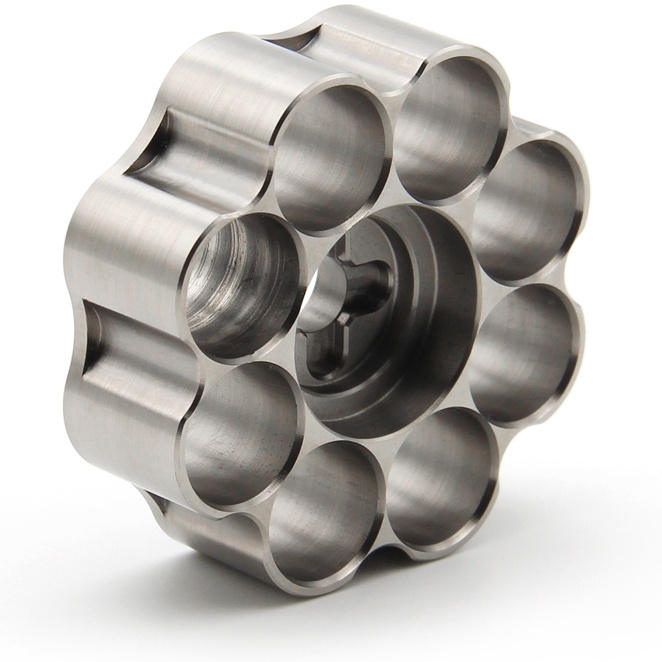


Stainless Steel Milling is a precision CNC Machining process used to manufacture stainless steel components with accurate dimensions, complex geometries, and consistent quality. Using advanced CNC milling machines, manufacturers can produce custom parts for industrial equipment, automotive systems, medical devices, electronics, food processing machinery, and other demanding applications.
With Stainless Steel CNC Milling, cutting tools remove Material from a stainless steel workpiece according to a programmed design. This process allows manufacturers to produce prototypes, small batches, and high-volume Stainless Steel Milling Parts with repeatable precision.
Stainless Steel Milling is a subtractive manufacturing process in which rotating cutting tools remove material from stainless steel to create a finished component.
Depending on the part design, CNC milling can perform operations such as:
Face milling
End milling
Slot milling
Pocket milling
Drilling
Tapping
Contouring
Chamfering
Precision surface machining
CNC Milling Stainless Steel is particularly suitable for parts that require tight tolerances, complex shapes, and consistent dimensions across multiple production batches.
Different stainless steel grades can be selected according to the mechanical, chemical, and environmental requirements of the finished part.
304 stainless steel is widely used because of its good corrosion resistance, formability, and general-purpose performance. It is suitable for industrial components, equipment parts, food processing equipment, and many other applications.
316 stainless steel provides enhanced corrosion resistance compared with 304, particularly in environments involving moisture, chemicals, and salt exposure. It is commonly considered for marine, chemical processing, medical, and food-related applications.
303 stainless steel is designed for improved machinability, making it suitable for precision components that require efficient CNC Machining and good dimensional consistency.
17-4 PH stainless steel combines high strength with corrosion resistance and can be used for demanding mechanical components, aerospace parts, industrial equipment, and other applications where strength is important.
The appropriate material should be selected according to the part's operating environment, strength requirements, corrosion resistance, and machining requirements.
A professional Stainless Steel CNC Milling process normally includes several stages to achieve the required part specifications.
The machining process begins with a 2D drawing or 3D CAD model. The design is converted into CNC machining instructions that control tool movement, cutting speed, feed rate, and other machining parameters.
The selected stainless steel material is prepared according to the required dimensions. Proper workholding is important because stainless steel components must remain stable during machining.
The CNC machine removes material using precision cutting tools. Depending on the part geometry, multi-axis machining can be used to reach different surfaces and create complex features.
Finished Stainless Steel Milling Parts are inspected to verify dimensions, tolerances, surface quality, and other customer requirements.
Additional finishing processes can be applied when required, including polishing, grinding, brushing, passivation, bead blasting, and electropolishing.
Stainless Steel CNC Milling provides several advantages for precision component manufacturing.
CNC machining uses computer-controlled tool movements to produce components with consistent dimensions and repeatable accuracy.
CNC milling can manufacture slots, pockets, holes, contours, and other complex features that may be difficult to produce using conventional machining methods.
Once the CNC program has been verified, the same machining process can be repeated to manufacture multiple components with consistent specifications.
Custom Stainless Steel Milling allows manufacturers to produce parts according to customer drawings, CAD files, dimensions, tolerances, and functional requirements.
Stainless steel provides a useful combination of strength, corrosion resistance, and durability, while CNC milling provides the precision needed for complex components.
Custom Stainless Steel Milling is suitable when standard off-the-shelf components cannot meet specific design or performance requirements.
Customers can provide:
2D engineering drawings
3D CAD files
Sample parts
Material specifications
Dimensional tolerances
Surface finish requirements
Quantity requirements
Based on the design and application, a CNC machining manufacturer can recommend suitable stainless steel grades, machining processes, tooling, and finishing methods.
After machining, different surface treatments can be used to improve appearance, corrosion resistance, or functional performance.
Common options include:
| Surface Finish | Typical Purpose |
|---|---|
| Brushing | Creates a uniform directional surface |
| Polishing | Improves surface smoothness and appearance |
| Grinding | Provides controlled surface finish and dimensional accuracy |
| Bead Blasting | Creates a uniform matte appearance |
| Passivation | Helps improve the corrosion resistance of stainless steel |
| Electropolishing | Improves surface cleanliness and smoothness |
The appropriate finishing method depends on the material grade and final application.
Stainless Steel Milling Parts are used across many industries because stainless steel offers a combination of strength, durability, and corrosion resistance.
CNC-milled stainless steel components can be used for machine parts, fixtures, brackets, housings, shafts, and other mechanical components.
Stainless steel CNC parts can be manufactured for selected automotive systems, fixtures, connectors, and specialized components.
Precision-machined stainless steel components can be used in medical equipment and instruments where dimensional accuracy, corrosion resistance, and clean surfaces are required.
Stainless steel is widely used in food processing equipment because of its corrosion resistance and suitability for applications requiring hygienic surfaces.
For environments exposed to moisture and salt, suitable stainless steel grades such as 316 may be considered for CNC-machined components.
Small precision stainless steel components can be used in automation equipment, electronic devices, fixtures, and mechanical assemblies.
Choosing an experienced Stainless Steel Milling Manufacturer is important when producing precision components with specific dimensional and material requirements.
A professional manufacturer should be able to provide:
CNC milling capabilities
Multiple stainless steel material options
Custom machining services
Precision dimensional inspection
Surface finishing
Prototype and production machining
Technical support
Quality control
Flexible production quantities
For complex or high-precision components, the manufacturer's machining equipment, tooling capabilities, inspection equipment, and production experience should all be considered.
Stainless Steel Milling combines the material advantages of stainless steel with the precision of CNC machining.
It can be an effective manufacturing solution when a component requires:
Precise dimensions
Complex geometries
Good corrosion resistance
High mechanical strength
Consistent production quality
Custom dimensions
Multiple surface finishing options
From prototypes to production batches, CNC Milling Stainless Steel can be adapted to different component designs and production requirements.
Stainless Steel Milling is a CNC machining process that uses rotating cutting tools to remove material from stainless steel and create precision components according to a specific design.
304, 316, 303, and 17-4 PH stainless steel are commonly considered for CNC machining. The appropriate grade depends on machinability, strength, corrosion resistance, and the final application.
Stainless Steel CNC Milling can produce brackets, housings, fixtures, machine components, connectors, shafts, plates, and other custom precision parts.
Yes. Custom Stainless Steel Milling can be used to manufacture components according to customer drawings, CAD models, material specifications, tolerances, quantities, and surface finishing requirements.
Stainless Steel Milling is a specific CNC process that uses rotating cutting tools to remove material. Stainless Steel CNC Machining is a broader term that can include milling, turning, drilling, tapping, and other CNC machining operations.
Consider the manufacturer's CNC equipment, machining experience, available stainless steel grades, dimensional inspection capabilities, surface finishing options, production capacity, and ability to meet your specific drawings and tolerances.

JIESHENG HARDWARE is a professional manufacturer that focuses on customizing High- Precision Hardware Spare Parts more than 20 years of experience.
Copyright © 2026 Dongguan Jiesheng Hardware Industry Co., Ltd. All rights reserved. Privacy Policy


 English
