



 English

When sourcing custom CNC machined parts, the quality of your RFQ (Request for Quotation) directly affects the quality of the quotation you receive.
Many buyers assume that sending a CAD file and asking for a price is enough. However, incomplete RFQs often lead to delayed responses, inaccurate pricing, engineering misunderstandings, and costly production revisions.
At CNC Parts China, we receive RFQs from customers worldwide every day. One thing we've learned is that the most successful projects start with a complete and well-prepared RFQ package.
In this guide, we'll explain exactly how to send an RFQ for CNC machining parts and what information CNC manufacturers need to provide accurate pricing, lead times, and manufacturing recommendations. A complete RFQ package helps suppliers quote faster and reduces ambiguity during production.
What Is an RFQ for CNC Machining Parts?
An RFQ (Request for Quotation) is a formal request sent to a CNC Machining supplier asking for pricing, lead time, and manufacturing feasibility information for a custom part.
A professional RFQ allows the supplier to evaluate:
· Part geometry
· Material requirements
· Machining complexity
· Surface finishing needs
· Inspection requirements
· Production quantity
· Delivery schedule
The more complete your RFQ is, the more accurate the quote will be. Incomplete RFQs often force suppliers to make assumptions, which can increase costs or delay production.
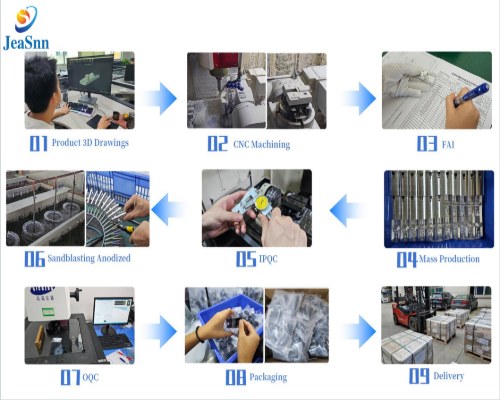
Step 1: Provide 3D CAD Files
The first thing every CNC machining manufacturer needs is a 3D model.
Preferred formats include:
· STEP (.stp)
· STP
· IGES (.igs)
· Parasolid (.x_t)
· SolidWorks files
Among these formats, STEP files are generally the most widely accepted and allow engineers to review geometry, tool accessibility, and machining strategy efficiently.
At CNC Parts China, our engineering team performs a Design for Manufacturing (DFM) review before production to help customers optimize costs and improve manufacturability.
Step 2: Include Detailed 2D Drawings
While the 3D model defines geometry, the 2D drawing defines manufacturing requirements.
Your drawing should include:
· Critical dimensions
· Tolerances
· Thread specifications
· Surface finish requirements
· Datum references
· Geometric tolerances (GD&T)
· Special notes
Professional RFQ guides emphasize that the drawing is often the most important document because it communicates what dimensions are critical and how the part will be inspected.
Step 3: Specify Material Requirements Clearly
Material selection significantly impacts machining cost, lead time, and part performance.
Instead of simply writing "Aluminum" or "Stainless Steel," specify exact grades such as:
Aluminum
· Aluminum 6061-T6
· Aluminum 7075-T6
· Aluminum 5052
Stainless Steel
· Stainless Steel 303
· Stainless Steel 304
· Stainless Steel 316
Other Materials
· Brass C360
· Copper C110
· Titanium Grade 5
· POM (Delrin)
· Nylon
· PTFE
· PEEK
Accurate material callouts help suppliers avoid assumptions and quote correctly from the beginning.
Step 4: State Quantity Requirements
One of the most common RFQ mistakes is forgetting to specify quantities.
Pricing for:
· 1 prototype
· 10 pieces
· 100 pieces
· 1,000 pieces
can vary dramatically because setup costs are distributed differently across production volumes.
Step 5: Define Surface Finish Requirements
Surface treatment can account for a significant portion of total manufacturing cost.
Common finishing requirements include:
· Anodizing
· Hard Anodizing
· Black Oxide
· Zinc Plating
· Nickel Plating
· Powder Coating
· Bead Blasting
· Polishing
· Passivation
Step 6: Include Inspection and Quality Requirements
Different Industries have different quality requirements.
Your RFQ should indicate whether you require:
· First Article Inspection (FAI)
· CMM Inspection Report
· Material Certificate
· Certificate of Conformance (COC)
· PPAP Documentation
· Inspection Reports
Providing this information upfront allows suppliers to prepare accurate quality plans and quotations. Inspection requirements are commonly included in professional RFQ checklists.
Step 7: Tell the Supplier Your Target Lead Time
Lead time affects both pricing and production planning.
Clearly indicate:
· Prototype deadline
· Production schedule
· Shipping deadline
· Project milestones
For example:
· Prototype needed in 7 days
· Production required within 30 days
· Scheduled product launch date
This allows the CNC machining supplier to recommend the most efficient production strategy.
Sending a professional RFQ is one of the easiest ways to reduce sourcing risks and receive faster, more accurate CNC machining quotes.
A complete RFQ should include:
✓ 3D CAD model
✓ 2D engineering drawing
✓ Material specification
✓ Quantity requirements
✓ Surface finish requirements
✓ Tolerances
✓ Quality documentation requirements
✓ Target lead time
The more information you provide, the faster a CNC machining manufacturer can evaluate your project and deliver a reliable quotation.
If you're looking for a trusted CNC machining supplier in China, CNC Parts China can help with rapid quotations, DFM analysis, prototype machining, and production manufacturing for custom metal and plastic parts.Please contact:engineer@cncpartschina.com