



 English

As product designs become more complex, traditional 3-axis machining is often no longer enough to meet modern manufacturing requirements. Industries such as aerospace, medical devices, robotics, automotive, industrial automation, and electronics increasingly require complex geometries, tighter tolerances, and faster production cycles.
This is why more companies are turning to multi-axis CNC machining services.
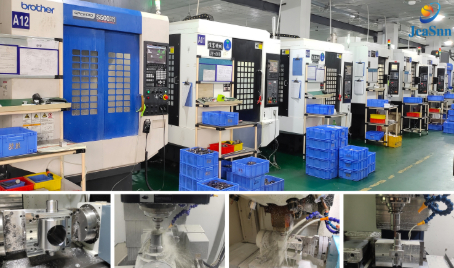
At JeaSnn, we provide advanced 3-axis, 4-axis, and 5-axis CNC Machining solutions for customers worldwide. With dedicated 4-axis and 5-axis machining centers, we help customers manufacture complex custom CNC-machined parts with higher precision, shorter lead times, and lower overall production costs.
What Is Multi-Axis CNC Machining?
Multi-axis CNC machining refers to CNC machines capable of moving along more than three axes simultaneously.
While traditional 3-axis machining operates along X, Y, and Z directions, multi-axis machines add rotational movements, allowing the cutting tool to approach the workpiece from multiple angles without repeated repositioning.
Common configurations include:
4-Axis CNC Machining
5-Axis CNC Machining
imultaneous 5-Axis Machining
Multi-Axis Mill-Turn Machining
This capability allows manufacturers to machine highly complex parts in fewer setups while maintaining superior dimensional accuracy.
1. Significantly Higher Precision
One of the biggest advantages of multi-axis CNC machining is improved accuracy.
In traditional machining, operators often need to remove and reposition parts several times. Every additional setup introduces potential positioning errors.
With 5-axis CNC machining, multiple surfaces can be machined in a single setup, reducing fixture changes and minimizing cumulative tolerance errors. This leads to:
Better dimensional consistency
Improved geometric accuracy
Reduced tolerance stack-up
Higher repeatability for production runs
For industries requiring tight tolerance CNC machining services, such as medical equipment and aerospace components, this advantage is critical.
2. Machine Complex Geometries That 3-Axis Machines Cannot
Modern products increasingly feature:
Deep cavities
Curved surfaces
Complex contours
Angled holes
Multi-sided features
These designs can be extremely difficult—or sometimes impossible—to produce efficiently using conventional CNC milling.
Multi-axis CNC machining allows cutting tools to approach the workpiece from virtually any direction, making it possible to manufacture:
Aerospace brackets
Medical implants
Turbine components
Robotic parts
Precision sensor housings
Custom automation equipment components
At JeaSnn, our 5-axis machining centers are regularly used for customers requiring complex CNC-machined parts with intricate geometries and demanding specifications.
3. Reduced Setup Time and Faster Production
Every setup adds time.
Traditional machining often requires operators to:
Remove the part
Re-clamp the part
Re-align the datum
Verify positioning
Continue machining
Multi-axis machining dramatically reduces these steps.
Because multiple faces can be machined in one operation, manufacturers can shorten production cycles while reducing labor costs.
Benefits include:
Faster prototype development
Shorter lead times
Reduced machine downtime
Higher throughput
For customers needing rapid CNC prototyping services or low-volume production machining, multi-axis machining can significantly accelerate project timelines.
4. Lower Manufacturing Costs for Complex Parts
Many buyers assume 5-axis machining is expensive.
In reality, for complex parts, multi-axis machining often reduces total manufacturing costs.
Cost savings come from:
Fewer setups
Less manual labor
Reduced fixturing requirements
Lower inspection time
Less scrap
Shorter production cycles
When producing high-complexity components, a single 5-axis operation may replace several separate machining operations, improving efficiency and reducing overall cost.
5. Improved Consistency in Production Runs
For OEM manufacturers and industrial equipment suppliers, consistency is just as important as precision.
Multi-axis machining improves process stability because:
Parts remain in a single setup
Human intervention is minimized
Datum references remain consistent
Automated machining paths improve repeatability
This ensures every component matches the original design specifications, even across large production quantities.
Why Choose JeaSnn for Multi-Axis CNC Machining?
Choosing the right CNC machining supplier is just as important as choosing the right machining technology.
JeaSnn combines advanced machining equipment with experienced engineering support to help customers optimize designs and reduce manufacturing costs.
Our Capabilities include:
3-Axis CNC Milling
4-Axis CNC Machining
5-Axis CNC Machining
CNC Turning and Milling
CNC Prototyping
Surface Finishing Services
Key advantages:
ISO 9001 & IATF 16949 certified
DFM support before production
Fast quotation response
Prototype to mass production capability
Tight tolerance CNC machining
Global shipping support
Our engineering team reviews every drawing carefully to identify opportunities for improved manufacturability, reduced cost, and faster delivery.
If you have any needs for customized products, please contact us promptly:engineer@cncpartschina.com