



 English

When designing custom components, engineers often focus heavily on part functionality, strength, and aesthetics. However, one critical factor is frequently overlooked until the manufacturing stage: production cost.
In the competitive world of manufacturing, optimizing your design for the machining process is the most effective way to lower expenses. As a leading custom CNC machining services provider at JeaSnn, we work closely with procurement managers and product engineers daily. This ultimate guide breaks down practical Design for Manufacturability (DFM) strategies to optimize your custom CNC machining parts and significantly cut down your CNC Machining costs without sacrificing quality.
1. Optimize Internal Radii and Corners
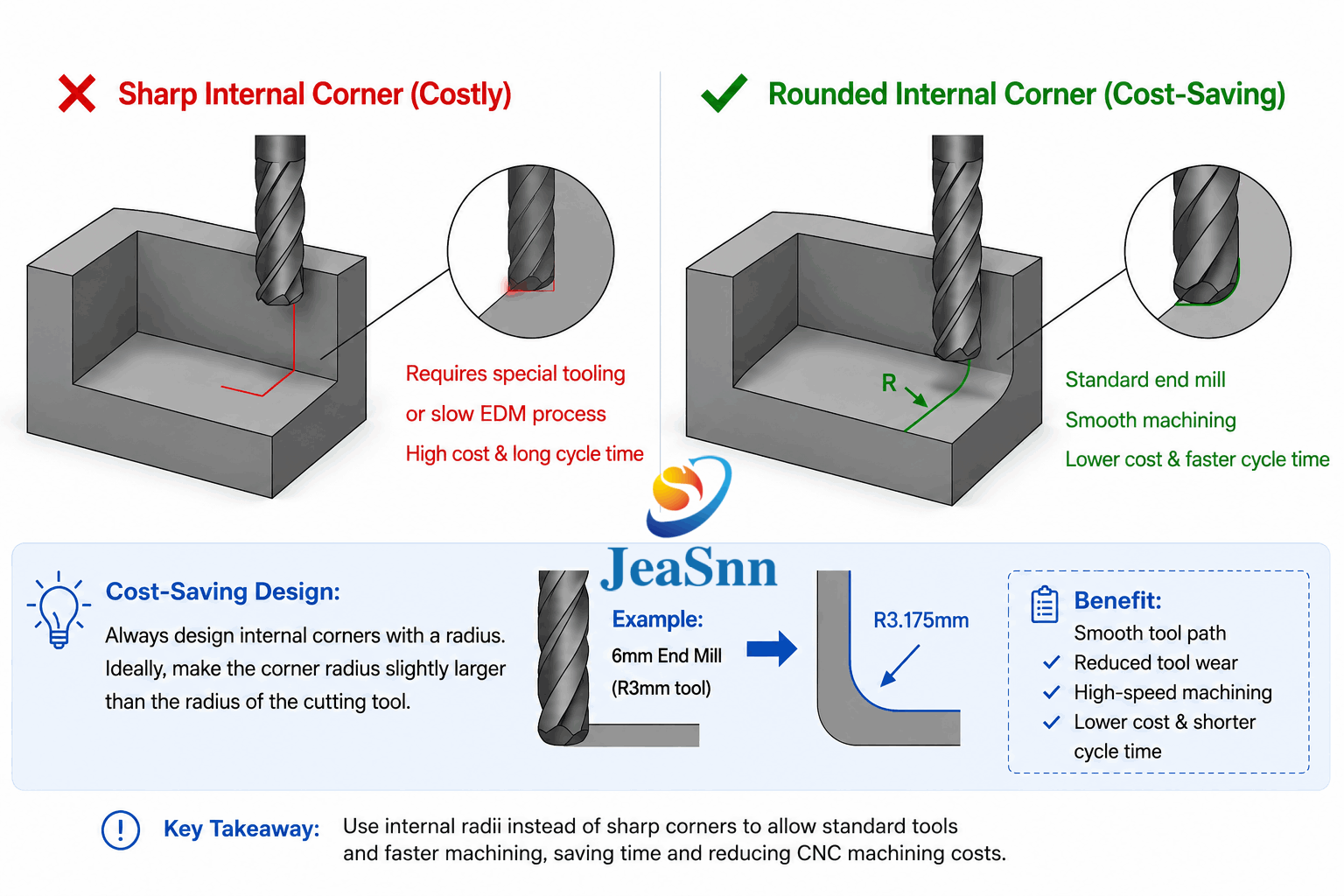
One of the most common cost drivers in precision CNC Machining is the specification of perfectly sharp internal corners.
The Challenge: CNC Milling tools are round (end mills). Machining a sharp 90°internal corner requires specialized, slower processes like EDM (Electrical Discharge Machining) or incredibly small tooling, which skyrockets CNC milling costs.
The Cost-Saving Design: Always design internal corners with a radius. Ideally, make the corner radius slightly larger than the radius of the cutting tool (e.g., if using a 6mm end mill, use a 3.175mm radius). This allows the tool to transition smoothly around corners at high speeds, reducing tool wear and drastically cutting cycle times for your custom CNC parts.
2. Avoid Deep and Narrow Pockets
Deep cavities might look great on a 3D CAD model, but they present a massive technical hurdle during actual CNC machine operations.
The Challenge: To mill a deep pocket, longer cutting tools are required. Long tools are prone to tool deflection, vibration (chatter), and breakage, which forces the CNC machining manufacturer to slow down the cutting speeds.
The Cost-Saving Design: As a rule of thumb for cost-effective custom CNC machining, limit the depth of a pocket to no more than 4 times its width. If a deeper cavity is structurally necessary, consider designing the component as two separate pieces that can be bolted or assembled together post-machining.
3. Standardize Threaded Holes and Taps
Adding threads allows parts to be easily assembled, but over-specifying thread depth or using non-standard thread sizes will quickly drive up your CNC prototyping costs.
The Challenge: Tapping deep holes increases the risk of tap breakage. Removing a broken tap from a nearly finished precision CNC turned part is highly labor-intensive and often ruins the component entirely.
The Cost-Saving Design: Limit thread length to 2 times the hole diameter. Most of the holding power of a screw occurs in the first few threads anyway. Furthermore, always stick to standard metric (e.g., M3, M4, M5) or imperial thread sizes that use off-the-shelf tooling. Custom thread sizes require specialized taps, adding unnecessary expenses to your custom CNC machining parts.
4. Relax Tolerances Wherever Possible
While high-precision manufacturing is our specialty at Jiesheng Hardware, specifying overly tight tolerances across an entire blueprint is an immediate recipe for inflated invoices.
The Challenge: Tight tolerances (like ±0.005mm) demand specialized cutting tools, continuous in-process metrology, slower feed rates, and higher scrap rates.
The Cost-Saving Design: Only assign tight tolerances to critical interface surfaces, such as bearing seats or alignment pins. For non-critical dimensions, stick to standard workshop tolerances (like ±0.1mm or ISO 2768-m). Relaxing non-functional tolerances streamlines production on our multi-axis CNC machining centers and drops the per-part price dramatically.
5. Minimize Setup Changes and Part Rotations
Every time a machinist has to manually stop the CNC machine, flip your part, and re-clamp it to machine another face, labor costs accumulate.
The Challenge: Multi-sided machining on standard 3-axis mills requires multiple setups. More setups mean more fixtures, longer lead times, and a higher chance of human alignment errors.
The Cost-Saving Design: Try to design your custom CNC components so they can be machined from a single orientation, or at most, two setups. If a part features intricate geometries on all six sides, utilizing advanced 5-axis CNC machining at JeaSnn can often consolidate setups, saving you significant setup fees on high-volume production runs.
Why Partner with cncpartschina.com for Your CNC Needs?
At JeaSnn, we aren't just a build-to-print machine shop. We act as your manufacturing partner. By choosing us as your trusted CNC machining manufacturer, you gain access to:
Expert DFM Feedback: Our engineering team reviews every single 3D CAD model to identify cost-saving opportunities before chips start flying.
Fast Lead Times & Flexible Volumes: From rapid CNC prototyping to high-volume manufacturing solutions, we align our shop floor with your schedule.
Comprehensive Material Selection: We stock a massive inventory of metals (Aluminum, Stainless Steel, Brass, Titanium) and plastics (POM, Nylon, PEEK) to meet your exact application demands
Ready to Lower Your CNC Machining Costs?
Don't let inefficient part designs blow your project budget. Get a professional manufacturability analysis from the experts.
Simply upload your 3D CAD files (STEP, IGES) and 2D engineering drawings (PDF) directly to our platform. Our dedicated engineers will analyze your design and provide a highly competitive, transparent CNC machining quote within 24 hours. Please contact us:engineer@cncpartschina.com